Technology
How Cloud-Based Asset Tracking Beats On-Premise Solutions
Compare cloud vs on-prem asset tracking for small IT teams by setup time, operating cost, maintenance overhead, and day-to-day reliability.
If your team is small, the real decision is usually not about architecture purity. It is about setup speed, admin burden, remote access, and how quickly you can trust the asset data.
Introduction
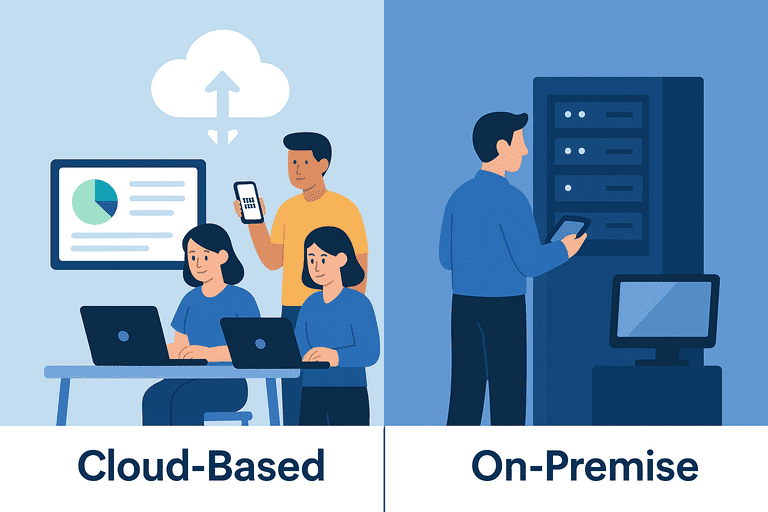
Small IT teams often compare cloud and on-prem asset tracking at the same moment they are trying to fix spreadsheet drift, unclear ownership, or slow return workflows.
That means the real question is not just "Where should the software run?"
It is:
- how much infrastructure can we realistically maintain?
- how fast can we roll this out?
- will remote and hybrid staff be easy to support?
- how much manual admin work are we adding?
For most lean teams, cloud wins because it reduces operational weight. On-prem can still fit, but only when there is a real hosting or compliance reason.
If the decision is specifically about choosing a hosted asset-tracking product, continue with the Cloud Asset Tracking Software: Small-Team Buyer Guide.
Quick Decision Summary
| If your situation is... | Choose |
|---|---|
| Replacing spreadsheets | ✅ Cloud |
| One office plus remote staff | ✅ Cloud |
| Multiple locations | ✅ Cloud |
| Government or defense constraints | ✅ On-prem |
| Strict local-hosting rules | ✅ On-prem |
What Choosing On-Prem Actually Changes
On-prem systems run on infrastructure your organization controls.
That usually means:
- more control over hosting
- more responsibility for updates, backups, and uptime
- more internal work around security patching and monitoring
- slower rollout for smaller teams
For organizations with genuine local-hosting requirements, that may be acceptable. For a small team already stretched thin, it is often extra work with limited operational upside.
What Choosing Cloud Actually Changes
Cloud systems are delivered through the web and mobile access.
That usually means:
- faster deployment
- lower infrastructure overhead
- easier support for remote or multi-site teams
- automatic updates, security patching, and backups handled as part of the service
For most small organizations, cloud providers usually invest more in infrastructure security, patching, and monitoring than a small internal IT team can realistically maintain on its own.
Decision Matrix for Small IT Teams
| Decision point | Cloud | On-prem |
|---|---|---|
| Setup speed | Faster | Slower |
| Admin burden | Lower ongoing infrastructure work | Higher internal maintenance work |
| Remote / hybrid support | Strong by default | Usually needs more setup |
| Scaling users or locations | Easier | Heavier planning |
| Backup responsibility | Vendor-managed | Internal responsibility |
| Best fit | Lean teams that need momentum | Teams with a real local-hosting requirement |
Cost Is Not Just the Subscription
The real comparison is not simply "Which is cheaper?"
It is:
Which option costs less to operate over the next three years?
For many small teams, on-prem costs include:
- server hardware
- storage
- backup design and monitoring
- upgrade work
- security patching
- ongoing IT time
Cloud shifts most of that burden into a more predictable subscription model. That does not mean cloud is always cheaper in every environment, but it often costs less to operate for a lean team.
Why Cloud Usually Wins for Lean Teams
1. Faster path out of spreadsheet drift
If your current problem is unclear ownership, missing return history, or unverified assets, cloud systems usually get you into a working operational model faster.
2. Less infrastructure overhead
Small teams rarely want to spend their limited time maintaining another internal service. With most cloud platforms, updates, security patches, and recovery procedures are part of the service rather than another internal responsibility.
3. Better support for distributed work
If assets move between homes, offices, and shared spaces, cloud access matters.
Related guide: Asset Tracking in Remote and Hybrid Work Environments.
4. Easier integration path
Cloud platforms also tend to simplify integrations with HR systems, identity providers, accounting software, and communication tools because they expose modern APIs by default.
Reference: The Role of APIs in Modern Inventory Systems.
When Cloud Is Probably Not the Right Fit
Cloud is probably not the right fit if:
- regulations require local hosting
- your organization cannot use SaaS services
- internet access is consistently unreliable
- you already operate an internal infrastructure team that manages similar systems efficiently
The point is to choose on-prem for a real operational reason, not because it sounds more enterprise-grade.
Practical Migration Path
A practical migration often looks like this:
- Import existing assets.
- Standardize asset IDs.
- Print QR labels.
- Clean assignment history.
- Run the first audit.
- Integrate HR, accounting, or other systems later.
If the comparison is really "cloud tool vs ERP module," use: Asset Tracking Software vs ERP Modules for Small Teams.
Migration Example
A company with:
- 150 laptops
- 60 monitors
- 2 offices
starts by:
Week 1
- import the spreadsheet baseline
- clean asset names and IDs
Week 2
- print QR labels
- start assigning assets through one system of record
Week 3
- clean assignment and return history
- fix obvious ownership gaps
Month 2
- run the first audit
- review exception patterns
Only after the process is stable does the team integrate HR or accounting systems.
That sequence usually matters more than the deployment model itself.
Common Mistakes
- treating cloud vs on-prem like a branding choice instead of an operating-model choice
- underestimating the admin load of on-prem maintenance
- keeping both spreadsheet and system workflows alive for too long
- debating infrastructure before fixing ownership, returns, and audits
FAQ
Is cloud asset tracking secure enough?
For many small organizations, yes. The real question is whether your team can realistically maintain patching, monitoring, backups, and access control internally at the same level over time.
Can cloud asset tracking work offline?
Often yes, if the product supports offline capture or queued updates. Offline behavior depends more on the specific system and mobile workflow than on the cloud label alone.
When should a small IT team choose on-prem instead?
Choose on-prem when there is a genuine regulatory, hosting, or infrastructure reason to do so, not just a preference for internal control.
Conclusion
Most small IT teams do not struggle because they picked the wrong deployment model.
They struggle because asset ownership, return history, and audits become inconsistent over time.
Cloud removes much of the infrastructure work so the team can focus on keeping asset data accurate. Choose on-prem only when your organization has a genuine operational or regulatory reason to host the system internally.
Related reading
- Asset Tracking Software vs ERP Modules for Small Teams
- IT Asset Register Excel Alternative for Small IT Teams
- Asset Tracking in Remote and Hybrid Work Environments
- The Role of APIs in Modern Inventory Systems
- NFC vs QR Code Tracking
- Excel vs InvyMate: Why Spreadsheets Fail at Asset Tracking
- Risk Management in Asset Tracking — From Theft to Data Breaches
Methodology
- This page was reviewed against adjacent InvyMate workflow pages and the external references listed below.
- Recommendations are written for practical asset-tracking operations and are intended to stay specific about workflow scope, tradeoffs, and implementation boundaries.
- This page was reviewed as a workflow-technology explainer and is intended to stay practical about operational adoption rather than broad trend language.
- This page was reviewed as a selection or evaluation guide, so recommendations are framed around fit, admin overhead, and execution realism rather than exhaustive vendor coverage.
Related Standards and Guidance
- CIS Critical Security Control 1: Inventory and Control of Enterprise Assets · Center for Internet Security
- NIST SP 800-171 Rev. 3 · NIST
Try InvyMate
Start tracking assets with QR codes and scheduled audits.